Discussing Professional Skills for Career Success in the Technology Space

Global Lab Network hosted the first community call of the year 2023 on 31st of August on the topic, ‘Professional Skills for Career Success in the Technology Space’. It was discussed how young professionals could get ahead with their Tech careers leveraging core technical and translational skills. These insights, drawn from experienced professionals; Winifred Kotin a technology business leader, Francis Addai a senior software engineer and Enock Nyamador a GIS specialist, encompassed a comprehensive framework for achieving excellence in the technology sector. They shared some key skills that one must have to thrive in the Technology space.

The first speaker, Francis spoke on Professionals in technology excelling because of their problem solving and critical thinking capabilities. He spoke on how the journey begins with the art of identifying a problem. This initial step sets the foundation for finding innovative solutions, even when the answers are not immediately apparent. The ability to dissect complex issues and arrive at effective solutions is a skill that transcends domains, making it a cornerstone of success. He further went on to talk about how much of a daunting challenge it can be navigating the Technology Landscape and hence having a mentor can be invaluable. A mentor provides not only guidance but also a wealth of experience and wisdom. Their insights can help individuals navigate the industry’s nuances and make informed career decisions, ultimately contributing to their growth and development. He went on to highlight that, a growth mindset is a fundamental attribute in a tech professional’s toolkit and as they progress in their technology career, the importance of effective communication cannot be overstated. He made a key statement which is; “If you have an effective way of communicating your ideas, it is directly proportional to how fast you grow”. It becomes a pivotal skill in building relationships, conveying ideas, and garnering support. Developing clear and concise communication skills ensures you can surround yourself with advocates and possible collaborators.

Francis further emphasized on time management in a fast-paced tech industry. Good time management skills lead to optimizing productivity an essential aspect of maintaining a successful career trajectory. He also spoke on self-belief and accountability. Belief in oneself and the ability to deliver on commitments is foundational. It is not enough to accept tasks; true success comes from consistently meeting and exceeding expectations.

If you have an effective way of communicating your ideas, it is directly proportional to how fast you grow.

Francis Addai

The second speaker Enock shared his professional journey transitioning into the GIS space and how it began with a passion for scouting information. He spoke on how his curiosity around cartography led him to research on it and that led to a development of keen interest and propelled him to pursue his current career in GIS. Cultivating a curious tendency to explore new topics and domains can lead to unforeseen opportunities and broadened horizons. Tenacity and a relentless quest for knowledge drive growth. This drive encourages you to embrace change and transition between fields seamlessly, like Enock’s journey from cartography to GIS. He went on to speak on Volunteerism. The culture of volunteering offers abundant learning opportunities. Engaging in volunteer work not only contributes to personal growth but also expands your professional network and skillset. He further reiterated Francis’s point on communication leading to collaborators by adding the need for networking. It is a universal asset across all industries. Building a robust professional network facilitates access to opportunities, mentorship, and collaborations, which can be invaluable in the technology sector.

Snapshot of speakers and moderator

The conversation went on with speaker, Winifred sharing on how diversifying one’s skill set and seizing varied opportunities could lead to a multifaceted and fulfilling career. Don’t confine yourself to a single niche; explore new avenues for growth. She also spoke on recognizing and leveraging one’s innate talents and abilities. These unique strengths can set you apart and enable you to excel in your chosen field. She shared insights on innovation. Innovation is at the heart of technological progress. Continuously seeking ways to improve processes, products, or solutions is a key driver of success in the dynamic tech industry. She further shared why staying relevant to user needs is essential. Keeping a user-centric focus and delivering value to both your employer and end-users ensures long-term success and impact. She made a key statement which is “Be focused on delivering excellence”. When work is not delivered with excellence, time exposes the low quality of your work. She advised on leveraging adaptability and flexibility. The ability to adapt to evolving industry trends and demands is crucial. A flexible mindset allows you to navigate change effectively and remain resilient in the face of challenges.

Be focused on delivering excellence.

Winifred Kotin

In conclusion, success in the technology space is not solely dependent on technical skills; it also hinges on cultivating these vital professional skills and strategies. By embracing these principles, you can navigate the dynamic and ever-evolving technology sector with confidence and purpose.

Watch the full discussion in the video below and check out our community call for videos of our previous discussions. Our next event for the year, Science Café, will be held on 28th September 2023. Dr. Cyril D. Boateng will make a presentation on Geophysics as a Tool for Achieving the Sustainable Development Goals in Ghana, followed by an expert-led discussion on the topic. Register for the next event by clicking http://bit.ly/scicafe23. You’re also welcome to join our Facebook group or follow our Twitter feed to get quick updates on this and future events/activities.
Discussing the Role of R&D in Ghana’s Development

Global Lab Network hosted the final Science Cafe of 2021 on 17 December on the topic ‘The Role of R&D in Ghana’s National Development‘. The event attracted participants from academia, industry, the public sector, and the STEAM community given its interdisciplinary nature. With contributions from leading academic and industry experts, the session explored the R&D landscape in Ghana and proposed how it can be nurtured to spur national development.

The programme started with a presentation by the keynote speaker Mr Leo Ayerakwa. Leo is currently serving as a Senior Manager, Regulatory Strategy & Preclinical Sciences Expert in the Oncology Business Group at Eisai Pharma Europe Ltd, UK.

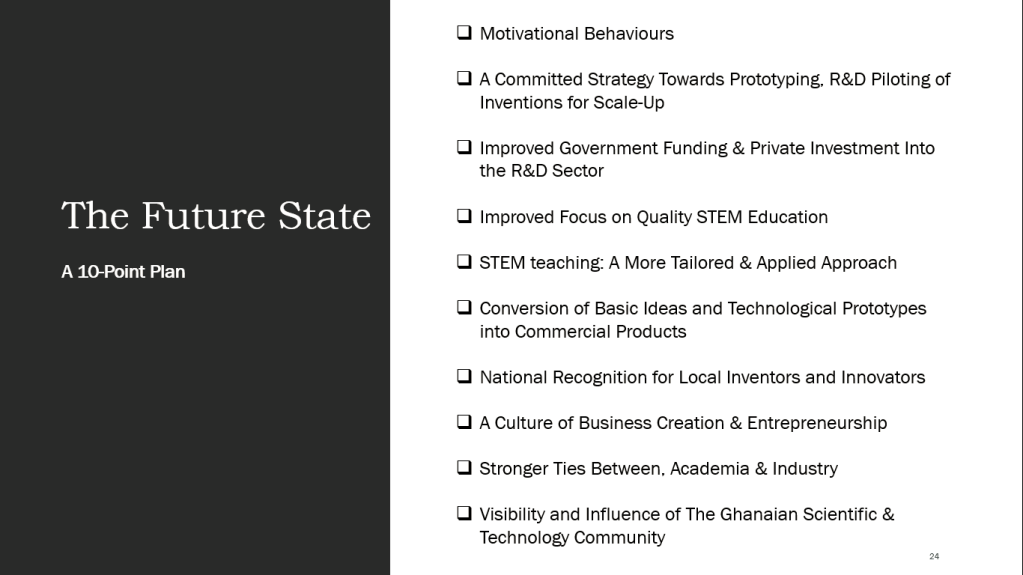
Leo’s presentation covered Ghana’s R&D policy and implementation framework, the current state of R&D in Ghana, and the future state of R&D. His recommendations for the future included a 10-point action plan diagnosing and addressing pain points/constraints to harnessing R&D for economic growth. One of the revelations of the presentation was the existence of an independent, non-governmental, and non-profit organisation called Research and Grant Institute of Ghana (ReGIG) dedicated to supporting research and innovation in Ghana by addressing inadequate funding and support for research in the country.

Explaining the linkages between research and economic performance

The presentation was followed by a moderated panel discussion reflecting on Leo’s submissions, and exploring how to address STEM education at all levels while providing pathways to meaningful engagement through jobs and innovation. Joining Leo in the panel discussion, moderated by GLab’s Gameli Adzaho, were Prof Marian Nkansah and Dr Kwame Sarpong Asiedu.

A ten-point proposal to transform R&D in Ghana

Prof Marian Nkansah is an environmental chemist at KNUST and a science communicator who is passionate about linking her research to society to create sustainable impact. She is a multiple award-winning scientist who is a Next Einstein Forum Fellow and an active member of the Global Young Academy. Dr Kwame Sarpong Asiedu on the other hand is a pharmacist and lecturer, with previous leadership roles in the pharmaceutical industry. He is a member of the Royal Pharmaceutical Society (UK) and the Pharmaceutical Society of Ghana, and a Democracy and Development Fellow in Health with the Ghana Centre for Democracy and Development.

The discussion centred around experiences with the research and development landscape in Ghana, good examples of STI implementation, existing gaps, funding research, going from research to innovation, public perception of science, and the way forward. The point was made that R&D, incorporating indigenous knowledge, can drive government’s One District One Factory initiative for example. The important relationship between research and industry was raised many times in the conversation, while the need to popularise science to inspire behaviour change among citizens was emphasised. On advocating for the scientific community at the highest levels of governance, it was recommended that the Presidential Advisory Council on Science, Technology and Innovation (PACSTI) should team up with the Ghana Academy of Arts and Sciences (GAAS).

The session, which was very interactive and engaging, attracted scientists and science enthusiasts in Ghana and beyond. Jekoniya Chitereka, a Zimbabwean science, technology, and innovation policy researcher at the University of Leeds, highlighted the importance of appreciating the non-linear or ‘spaghetti’ nature of the relationship between R&D and economic development. He emphasised the importance of developing strong relationships between various stakeholders to spur innovation. This also brings to mind the importance of interdisciplinary research that address complex challenges.

Snapshot of some of the participants

If scientific research and innovation should play its intended role in Ghana’s development, there is the need to make STEAM education in Ghana fit for purpose, while addressing the funding and infrastructure issues faced by researchers. We must challenge ourselves to implement the plans in our STI policy in order to realise the promise of R&D. Government, industry, academia, and civil society need to work more collaboratively to define, undertake, and utilise research to address local needs. To quote Leo, ‘it is about our collective effort in unlocking all that individual effort in a syngergistic way…’

Follow Global Lab Network on Twitter and Facebook to be updated on our future sessions or join our Community to contribute to our work and engage with likeminded science enthusiasts.

Video recording of the session

Global Lab Network to Host Three Experts to Discuss the Role of R&D in Ghana’s Development

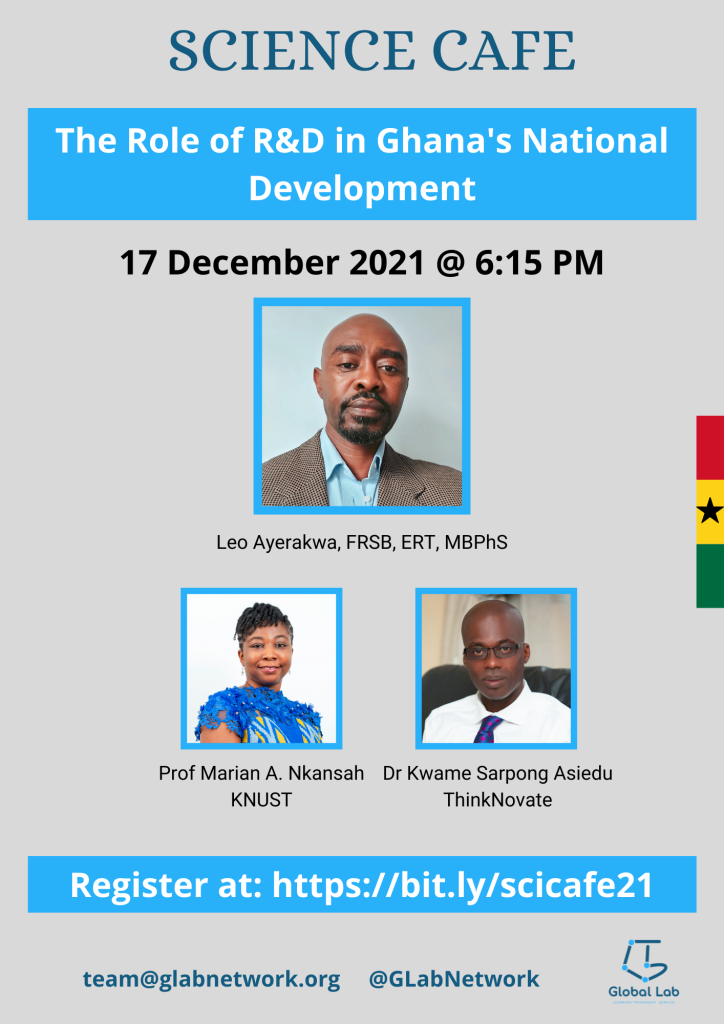
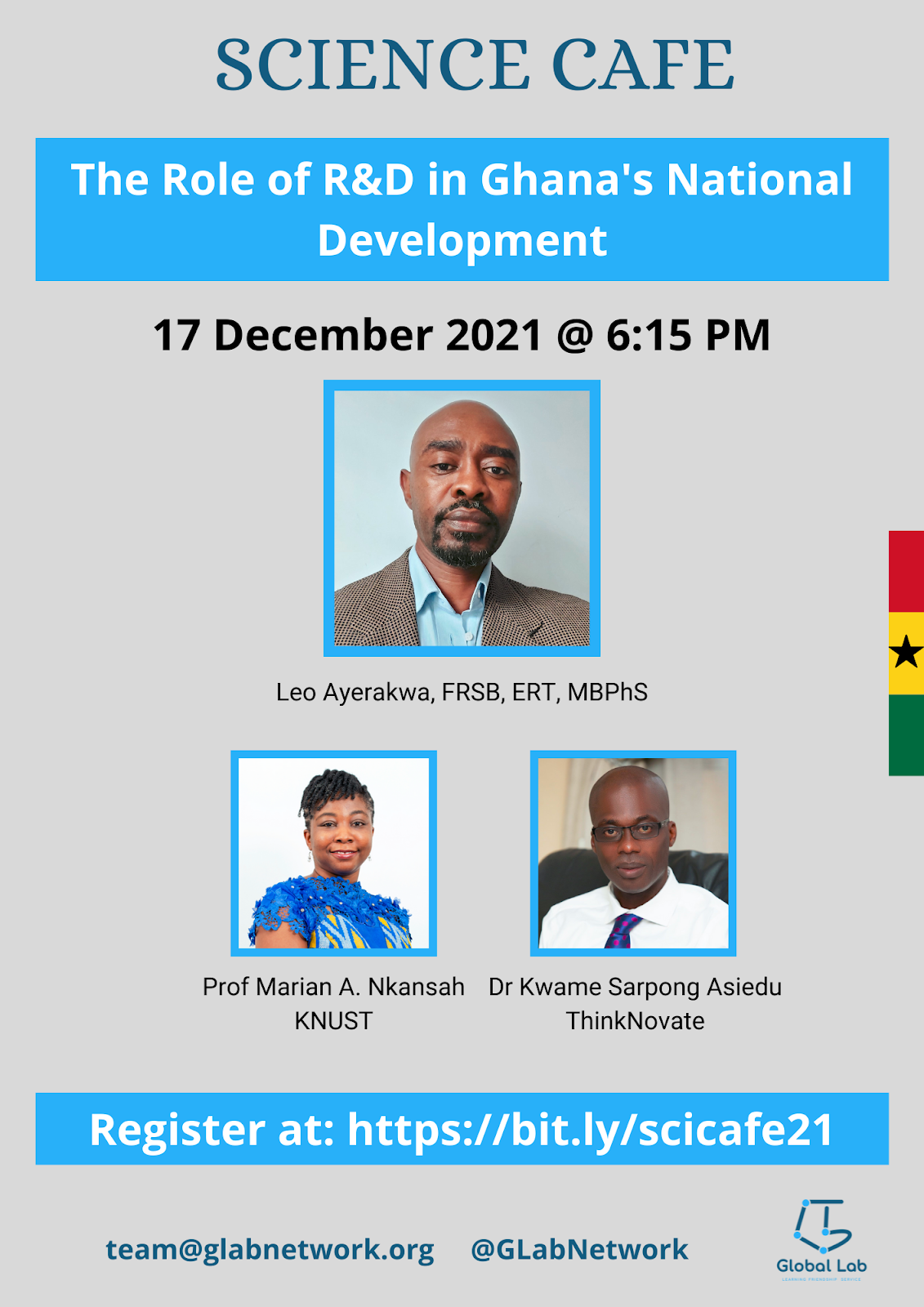
Global Lab Network is pleased to announce its final Science Cafe of the year. The event will be held online on Friday 17 December at 6:15 PM GMT under the theme The Role of Research and Development (R&D) in Ghana’s National Development.

The goal of the December 2021 edition of Science Cafe is to explore the current state of the R&D / technological sector in Ghana, as a transformative force in Africa’s development goals, with the help of key experts in academia and industry. The session will begin with a presentation by Leo Ayerakwa, FRSB, followed by a moderated discussion also featuring Professor Marian Nkansah and Dr Kwame Sarpong Asiedu, and conclude with an open discussion and Q&A session with all participants present.

Announcing December 2021 Science Cafe

The keynote Speaker, Mr Leo Ayerakwa has played a variety roles in medicines, pharmaceuticals and biomedical R&D over a 25-year career within the global pharmaceutical industry, graduating from University College, London (UCL), School of Pharmacy, University of London, and following post-graduate studies from universities in the UK.

He is currently serving as a Senior Manager, Regulatory Strategy & Preclinical Sciences Expert in the Oncology Business Group at Eisai Pharma Europe Ltd, UK with a broad therapeutic area experience in cancer, neurology, metabolic & cardiovascular diseases, having previously had a spell as a visiting professor on the Neuroscience MSc. course, Trinity College, University of Dublin.

Leo is a UK/EU board-certified toxicologist, advises biotech companies as a consultant, and was recently elected to the Fellowship of the Royal Society of Biology, UK.

Prof. Marian Asantewah Nkansah is an Associate Professor at the Department of Chemistry of the Kwame Nkrumah University of Science and Technology (KNUST), Kumasi, where she obtained her BSc. and MSc. degrees. She holds a PhD in Environmental Chemistry from the University of Bergen-Norway.

Prof. Nkansah’s research span a wide range of fields including finding solutions to environmental problems associated with levels and fate of toxic substances like heavy/trace metals, persistent organic pollutants (POPs) and polycyclic aromatic hydrocarbons (PAHs) in different environmental matrices. She has quite a number of peer reviewed articles and books to her credit.

Prof. Nkansah has received training in Science Diplomacy and Science Advice for Policy. She has been on both national and international platforms where science is discussed for better public understanding. She is a thought leader and motivational speaker.

Prof. Nkansah is a member of the Global Young Academy, an affiliate of TWAS and AAS, a member of the Ghana Young Academy and fellow of the Next Einstein Forum (NEF). She is the inaugural recipient of the TWAS F.M Al-Kharafi Prize and the 2021 winner of the OWSD-Elsevier Foundation Award for Women Scientists. She is the immediate Past Warden of Africa Hall of KNUST, a member of the Women in STEM Ghana group and is committed to the mentorship of younger females in their pursuit of STEM fields, and serves as a role model for young girls at the basic level of their education. She was recently selected to join the Executive Committee of the International Year of Basic Science for Sustainable Development (IYBSSD) scheduled for June, 2022 to June, 2023.  She enjoys teaching, storytelling, travelling and hiking.

Kwame Sarpong Asiedu is a Pharmacist whose pharmaceutical career spans over 22 years and has included stints in academia with universities in Ghana and the United Kingdom, as well as leadership roles with Boots UK Limited and Lexden Healthcare at the regional and global level.

He is a member of the Royal Pharmaceutical Society of Great Britain and Northern Ireland, the Pharmaceutical Society of Ghana as well as the Institute of Pharmacy Management International. He is also a Democracy and Development Fellow in Health with the Ghana Centre for Democracy and Development.

An accomplished Public Speaker, Kwame is passionate about public interest advocacy and the improvement of healthcare access across Ghana and the West African sub-region.

Some of the issues to be explored during the session include how to strengthen the R&D capacity in Ghana, determining the role of the private sector in building the R&D ecosystem, examining the progress of the proposed national research fund.

Science Cafe is a knowledge exchange and networking platform that connects scientists, innovators, and the general public, to promote community dialogue and scientific inquiry in informal venues such as coffee houses, bookstores, restaurants, bars, and online. Global Lab Network has organised 10 Science Cafes since 2018 featuring talks from researchers and innovators in public health, technology, mathematics, biotechnology, WASH, urban planning, environmental science, and public policy. These conversations have been useful in re-emphasising the importance of science, technology, and innovation to national development, and also helping to bridge the gap between science and society.

Everyone is welcome to attend the Science Cafe. To join this session kindly register at https://forms.gle/3QXuiVgeYVWuPMGF8.

How to Get Started in Data Analytics – Insights from Experience

Blog post on November 2021 Community Call by Geoffrey Gone

Data Analytics is one of the promising skills in the world of technology that has proved useful across all fields – from health, education, agriculture, construction, transportation, telecommunications, retail, banking, to finance. How does one harness this skill to ensure that impact is created on the Africancontinent?  Global Lab Network hosted its November 2021 Community Call to discuss how individuals can get started with data science. The speakers were Derek Degbedzui, Founder and Researcher with M.A.I.L.S-Connect, and Emmanuel Sekyi, Tech Lead at PaalUp.

Cross-section of the participants on the call

The discussion started with Derek mentioning data as one of the things we struggle to understand in terms of what it offers the world, and this makes it necessary for its study to solve problems. Data analytics in its simplest context enables us to have autonomy or control over the sources of data that we have gathered. He mentioned how important or useful data is and compared the traditional research process in academia to the real world, emphasising the role of modern data science in making broader and better decisions.

Derek further highlighted the failure of systems to solve future problems as a challenge to data science. He also demonstrated the thinking process that should be considered in building a system with the example of a ranking system for newsfeed. The major processes involved were setting goals and objectives and prioritizing these objectives. He also asked a mind-blowing question which is; “At what level should Africans be comfortable to say that we can use analytics to solve our problems and that they wouldn’t pose any challenge to us in the future?”  He answered by saying that Africans should engage in more research and our application or solutions should be explained to the public through engagements.

At what level should Africans be comfortable to say that we can use analytics to solve our problems and that they wouldn’t pose any challenge to us in the future?

Derek Degbedzui

The second speaker, Emmanuel, delved into the topic using a data-driven approach, to describe what beginners need to consider or learn to zoom into the field of data science. His approach used the data science process of gathering data (published articles), analysis, and interpretation to seek advice from the entire data science community. The approach used a public API from dev.to, with the hashtags #datascience #dataanalytics #beginners to gather 1 million data points relating to machine learning and data science. The data was then cleaned and insights extracted. Common themes or insights from the analysis were to learn how to build a model and learn the python programming language, pandas, numPy, and matplotlib.  

Emmanuel went further to explore some relevant skills needed as a beginner and refuted the advice of taking too many online courses. He further explained that those courses will not in themselves help you to become a data scientist, but by building stuff, you are most suited to work in the data science industry. The relevant skills one should learn were categorized into four groups:

  1. Getting data (data scraping/crawling, working with APIs, SQL)
  2. Asking a good question (unambiguous, questions whose answers are testable, what-if questions)
  3.  Programming languages (Python)
  4. Mathematics (Linear Algebra, Basic Calculus, Basic Statistics)

He also emphasized that one mistake people make is to think that technical skills are the most important thing in data science but he begs to differ. He stated that the best data scientist is one with domain knowledge who is learning data skills to apply to whatever domain they are working in. Emmanuel concluded his presentation by saying, a good data scientist should have: a core domain knowledge (46%), the ability to ask good questions (23%), programming skills (15%), and knowledge of mathematics (15%).

The conversation continued with questions, comments, and contributions from participants. Deborah Dormah Kanubala, a lecturer and researcher at Academic City University College, a participant on the call, talked about the essence of ethics in data science and research. She buttressed the point that machine learning engineers should not only focus on the performance of models but also ensure that their models are not biased or discriminatory towards any marginalized group or give the wrong result to any person underrepresented in the dataset. She highlighted the fact that engineers should be concerned about the source of the data and how it was collected to ensure that the data is a good representation of what they want to use it for.

Another participant, Soh asked Emmanuel to explain how machine learning has a bearing on data analytics. Emmanuel answered by saying that the science of working with data is data science. Everything that falls in the category of working with any form of data would fall under data science. The term data analytics is mostly used when you describe the application of data in industry or analysis of data for some insight. And machine learning is the application of mathematical methods to get insight from data. So, you can simply say that data science is a broad umbrella under which data analytics and machine learning falls.

Another participant, Harry asked about policies regarding the use of data on the continent mostly around people who are building health tech solutions. Derek answered by saying though real-world data collection has issues such as privacy and regulatory concerns we do not necessarily need the policy frameworks to be able to know the limits within which to operate. He made us understand that any team that works on a data project mostly relies on the advice of the technical person or the domain expert to provide the guiding principles. Failure to have the domain expert provide guidance could be detrimental. We can also open stakeholder engagement to know the limit within which to operate. Deborah added that the country has no well-defined policy or framework for data usage as compared to the general data protection regulation (GDPR) which is strictly adhered to in Europe. She added that some researchers use randomly generated data which needs no regulation and for publicly available data, the user should cite the source of the data. Kizito, a participant, also added that the constitution is a framework of all frameworks so we do not need an act specifically for data protection or regulation since the constitution has sufficient regulation to protect individual rights. Therefore, if any data company uses your data in a wrong manner you can go to the law court and seek redress.

Concluding, Emmanuel advised that the participants should build stuff that only they can build, i.e. in their domain of expertise. Derek also concluded that we should always remind ourselves of the call to duty, which is, for every opportunity that we have, we should be able to utilize them to benefit others and solve problems.

Watch the full discussion in the video below and check out our Community Call playlist for videos of our previous discussions. Our final event for the year, Science Cafe, will be held on 17 December 2021. Mr Leo Ayerakwa will make a presentation on The Role of R&D in Ghana’s National Development, followed by an expert-led discussion on the topic. You’re welcome to join our Facebook group or follow our Twitter feed to get quick updates on this and future events/activities.
Engaging Forces Senior High Technical School Students with STEM Skills and Careers

Blog post by Evans Owusu and Gameli Adzaho

Global Lab Network’s outreach initiative dubbed ‘Community Action’ is aimed at spiking the interest of young Ghanaians in STEM, through presentations, workshops, and hands-on activities. It also enables our Community members to give back while building on their planning, organising, leadership, and public speaking skills. 

May be an image of 5 people

Jacob Amengor leading a session on WASH at 2019 Nneka World Changers Camp

Recently, we partnered with Forces Old Students Association (FOSA) to engage current students of Forces Senior High Technical School at Burma Camp, Accra, through a one-day programme. The programme was focused on teaching students to develop their creativity and problem solving skills, and exposing them to a myriad of career opportunities possible with a STEM degree.

In the first session, Gameli Adzaho, who joined the session remotely via Zoom, highlighted the importance of developing creativity and problem-solving skills. He shared tips on how students can become better problem solvers, emphasising the importance of learning, networking, and gaining valuable experiences. Through examples of two young innovators, Kelvin Doe and Richard Turere, the students appreciated that it was possible to find solutions to some common local challenges even with minimal resources. The main takeaway from that session was the importance of applying knowledge gained from STEM to impact lives in local communities and around the world.

Next, Evans Owusu gave a talk on “Physics: the path to 21st century success.” Through this presentation he exposed students to various career options including Law, Education, Environment & Energy, Engineering, Media, Research, Information Technology, Finance, and High-Tech, open to people with STEM backgrounds. He went on to outline the skills one is likely to acquire from studying STEM degrees such as computing, report writing, critical thinking, programming, problem solving, and communication, among others. On key attitudes needed for success in STEM fields, Evans stressed the importance of passion, consistency, determination, resilience, as well as dedication.

Evans presenting to an attentive audience of students

Overall, it was a wonderful experience for the team to support FOSA in their bid to widen the horizons of the students and expose them to new possibilities. Over the past few years, we have been delivering sessions to young people in schools, universities, churches, and communities in both rural and urban areas. Some of the other topics we have covered so far include Design Thinking, Digital Literacy, Science Communication, and Environmental Stewardship. To learn more about Global Lab Network’s activities, kindly like our Facebook page, or if you would like to be more involved you can even join our Community!

Developing Basic Internet Safety and Media Literacy Skills

Report on our May 2021 Community Call

Seeing is not always believing and sharing is not always caring

Vanessa Otchere

Have you ever considered your safety on the internet? In an era where practically everything is going digital, with many activities transitioning online, one should be concerned about how to be safe online.  As many online interactions involve sharing personal data and leaving digital footprints on the web, many individuals, companies and countries have increasingly become concerned about cyber safety and the ramifications of privacy breaches. 

Another issue worthy of concern is our ability to tell whether the information we receive through online platforms is accurate. This is crucial since we make important decisions based on what we know, which is increasingly influenced by what we interact with online. We run the risk of being misinformed on key topics like climate change, political happenings, and the COVID-19 pandemic if we do not take care to properly evaluate information we receive. 

In an effort to increase awareness on cybersecurity and media literacy, this month’s Community Call was focused on exploring the concept and practice of internet safety and mis/disinformation. We were joined by three knowledgeable speakers on the Cyber Security to share tips on how to stay safe on the internet.

The session began with a brief round of introductions from participants and invited speakers. The first speaker, Confidence Mawusi, set the ball rolling by delineating the objectives for the session. In his opening statements he mentioned that “in our normal environment we have personal safety measures, however we pay least attention to our safety online”. He  defined online safety as acting safe on the internet and taking precautions to be safe. Confidence went ahead to state some internet threats and risks based on the actor/ internet user and threats based on devices. Some cases included cyberbullying, cyber dating abuse and sexting. He further shared a personal story of his experience with ransomware and stated other threats targeted at user devices: spam, adware, phishing and keyloggers.

After exploring the concepts and examples of internet risks, Confidence further shared some pointers on how to detect phishing and discussed malware and malware detection and prevention. Touching on Media Literacy, Confidence quoted Mark Twain “A lie can travel around the world and back again while the truth is lacing up its boots.” to illustrate how fast fake news travels. He shared how the human desire to satisfy curiosity hastens the proliferation of fake news. Confidence illustrated the difference between misinformation and disinformation and shared some approaches to break the cycle of disinformation. Some examples include fact checking and reading complete articles.

Computers will be computers , technology will be technology, in the end it is ethics and philosophy that will help us’

Next, Vanessa Otchere took off by explaining the key terminologies; Infodemic, disinformation, misinformation, malinformation, media and information literacy. 

She discussed the social psychology behind mis and disinformation which included the filter bubble, heuristics – mental shortcuts that help people solve problems quickly – and confirmation bias – interpreting and recalling information that reinforces our beliefs. Some practices she recommended to verify information were: comparing multiple sources of information, checking URLs, and being aware of underlying agenda of the information source. She concluded on the note “the ecosystem of information is a complex one and so is the technological age in which we live in. It’s everyone’s responsibility to verify information before sharing.” The session continued with participants offering feedback and sharing their filter bubbles.

Obasegun Ayodele of VilSquare in Nigeria joined us to share his work on the Glass Room project which is focused on how best to tackle fake news across Africa. Following the deeply engaging and incisive discussion, the session was concluded by Confidence sharing three helpful hints;

Social media will affect your mental health. On the internet, if you are not buying the product, you are the product and also, the internet never forgets. `Its either you have been hacked or about to be hacked.

Confidence Mawusi

After the revealing presentations and discussion, the event ended with a networking session.

You are welcome to be a part of the Global Lab Ghana Community on Facebook. Follow us on Twitter and subscribe to our YouTube Channel to be updated on our various activities.

Another exciting Science Cafe session is loading. Make a date with us!

Project Management – a Key Skill for Success in STEM

A report on our April 2021 Community Call with Edison Gbenga

Video recording from Community Call session.

Today, project management runs across a variety of sectors and industries. Many companies have embraced project management as a way to cut down cost, reduce risk and deliver on organizational goals. In the STEM industry, project management skills give you the ability to work with the increasing levels of complexities associated with projects in software development, bioscience research and health education. As a result, there is increasing demand for project management skills and knowledge.

In the Community Call session held in the month of April, we were led by Edison Gbenga to discuss a broad overview of Project Management with a focus on the approaches – Agile and Waterfall.

Edison Gbenga is a Business Strategist, Tech Evangelist and a Serial Entrepreneur. Since 2012, he has been serving as a strategist, coach and consultant for business owners and business developers of all sizes. His line of work ranges from business strategy consulting to process design and management  as well as web and mobile applications development. 

Edison began his presentation by giving a brief definition of project management. He described project management as the skill of moving from idea to results. In his presentation, he emphasised that project management permeates our daily lives; from planning a wedding to managing a country. He further indicated that project management has little to do with tools, procedures and recipes but more to do with mindset, practice and culture.

A good project manager knows how to solve problems, delegates effectively, works to meet deadlines and builds consensus.

Edison Gbenga

Following the introductory session, Edison proceeded to give a synopsis on two approaches to project management; Agile and Waterfall. He further described the SCRUM framework in Agile and how it helps teams work together. He delivered a detailed exposition on the two approaches and further discussed the advantages and disadvantages of these approaches. One major difference Edison illustrated in the two approaches is the iterative nature Agile employs between product design and testing as compared to the sequential order Waterfall follows. He reiterated the importance of team work, focus and discipline to project success.

The presentation was followed by a question and answer session, where Edison presented insightful answers based on his experience in working on varied projects. Some of the questions asked by participants include: How should a Project Manager manage non-compliant team members? What are the top skills needed to successfully implement a project? What products can we design to get people interested in STEM. 

Key Takeaways: What is Crucial to Project Success?

  • Having a solid team.
  • Managing people and dealing with negativity.
  • Understanding the time requirements of each task.
  • Emotional Intelligence and comprehension.

To learn more about ‘Developing Basic Internet Safety and Media Literacy Skills’ in our next Community Call to be held on May 28, 2021, you’re welcome to join the Global Lab Ghana Community on Facebook. Follow us on Twitter and subscribe to our YouTube Channel to be updated on our various activities.

Building Individual and Collective Resilience Beyond the COVID-19 Crisis

Report on Science Cafe held on March 2021

People who want to get things done will find a way to get it done, irrespective of the pandemic

Ato Ulzen-Appiah

This month we partnered with Ghana STEM Network to have an amazing discussion on the notion of resilience in a time of profound global change by examining experiences, reflections, research findings, and imaginations of what the future could look like or should be like, as part of our Science Cafe Series. We were also supported by GhScientific and Digital Times Africa. The event attracted about 36 participants from different fields of endeavour.

Snapshot of participants in the session.

What has the crisis changed? How can we weave through present and future challenges wrought by the pandemic? What does ‘resilience’ mean for us as individuals, Ghanaians, and global citizens? 

Key questions explored during the session

The program started with a brief presentation by Gameli Adzaho on Global Lab Network and Science Cafe, Evelyn Agyepong set the ball rolling by sharing some personal and global perspectives on the changes caused by the COVID-19 pandemic. In response to her thematic question ‘what has the crisis changed?’ Evelyn asked, `What hasn’t it changed’.  She discussed the challenges she faced as a leader and an educator in including new technologies in teaching and the accompanying personal stresses in connecting with family and loved ones.  In sharing her coping mechanisms with us, Evelyn disclosed that she engaged in science education with the public to increase knowledge on the virus and best practices to avoid its spread and connected with her family online through video calls and online games. Evelyn ended the discussion on the key note that

Evelyn Agyepong sharing personal and global perspectives on resilience

We will move forward, but life as we know it has definitely changed

Evelyn Agyepong

Ato Ulzen-Appiah of the Ghana Think Tank joined us to share some examples of individuals who have been resilient during the lockdown and the crisis as a whole. He mentioned how Ernest Tsifodze, who does a lot of work around motivational speaking, was able to go virtual, bringing people across Ghana together online for continued impact. Ato further stated that more people need to share how they’ve been able to cope with the pandemic to increase knowledge and awareness on how other individuals can do the same. He asserted that, in the midst of the pandemic, people who want to get things done will find a way to get it done irrespective of the current crisis, citing examples of Accra Konnect and Kumasi Konnect, as responses to the challenge of  physical meetups. 

Dr Thomas Tagoe giving his presentation

Dr Thomas Tagoe who is a Neuroscientist, Science Communicator and the Co-founder of GhScientific, discussed resilience from a neuroscience angle. Among the key points he posited on how to cope and subsequently thrive during the crisis include:

  • Acceptance; accepting that we may not be able to go back to the old way of doing things and usual outputs may have to be adjusted. Research has shown that by coming to terms with whatever context one finds themselves in, it is easier for new patterns and behaviors to develop.
  • Considering motivation and linking that with a cognitive approach; behavioural change occurs within people along two angles, the motivational element which involves the will to change and the more cognitive approach which deals with the how. This includes finding alternative approaches to achieving goals.
  • Community building; The mere idea of knowing that someone else is in the same situation you are in makes one feel better and helps with dealing with acceptance. It makes adjusting to new situations easier on the mind. 
  • Cognitive control;” People who have cognitive control have the ability to connect goals with actions”. He averred that it may seem obvious but our brains and our mental wellbeing is such that anything we are capable of is broken into the minimum components. Connecting actions to goals  is most critical for well-being, because mental health is the basis for resilience. 

Following the incisive presentation from Dr Thomas Tagoe, Solomon Appekey of the Ghana Planetarium and X Space Solutions gave us an eye-opening presentation  by taking us back 100 years on how the universe developed. Solomon discussed how the universe developed and explored the lessons we can learn from the growth in astronomical developments and how those lessons can be helpful during the current crisis.

Snapshot from Solomon Appekey’s presentation

Cecil Senna Nutakor joined us to share his views on some personal benefits of the pandemic. In his words “why the pandemic was supercool”, he lamented on how it had to take the occurrence of a pandemic to step up leadership in the country. According to him, the pandemic has drawn the government’s attention to infrastructural development, and the need to upgrade education (investing in digital) and health systems. In his recommendations on how we can forge ahead, he proposed an inclusive process in policy making process, a bottom-up approach in tackling the current crisis and fostering continued growth. 

After the submissions from the speakers, the participants broke into smaller sessions to share their perspectives on how they have been resilient during the crisis and ended the session with a group photograph.

Talk of #impactfromabus ! We had two speakers on long distance journeys joining us from a bus . You can definitely join us on our next Community Call via the Global Lab Ghana Community. Follow us on twitter and on Youtube to stay updated on our events.

If you’re interested in sharing your research or STEM-based project at a future Science Cafe, you’re welcome to register via this link.

See you in our upcoming Community Call next month!

Facilitating Science-Society Discourses in Ghana through the Science Cafe Model

Gameli Adzaho writes on Global Lab Network’s Science Cafe journey so far, from the very first event in August 2018 to our upcoming roundtable with the Ghana STEM Network.

Science Cafe is a knowledge exchange and networking platform that connects scientists, innovators, and the general public to promote community dialogue and scientific inquiry in informal venues like cafes, bookstores, restaurants and bars. We found the model quite interesting and yet simple so we decided to try it out.

Image
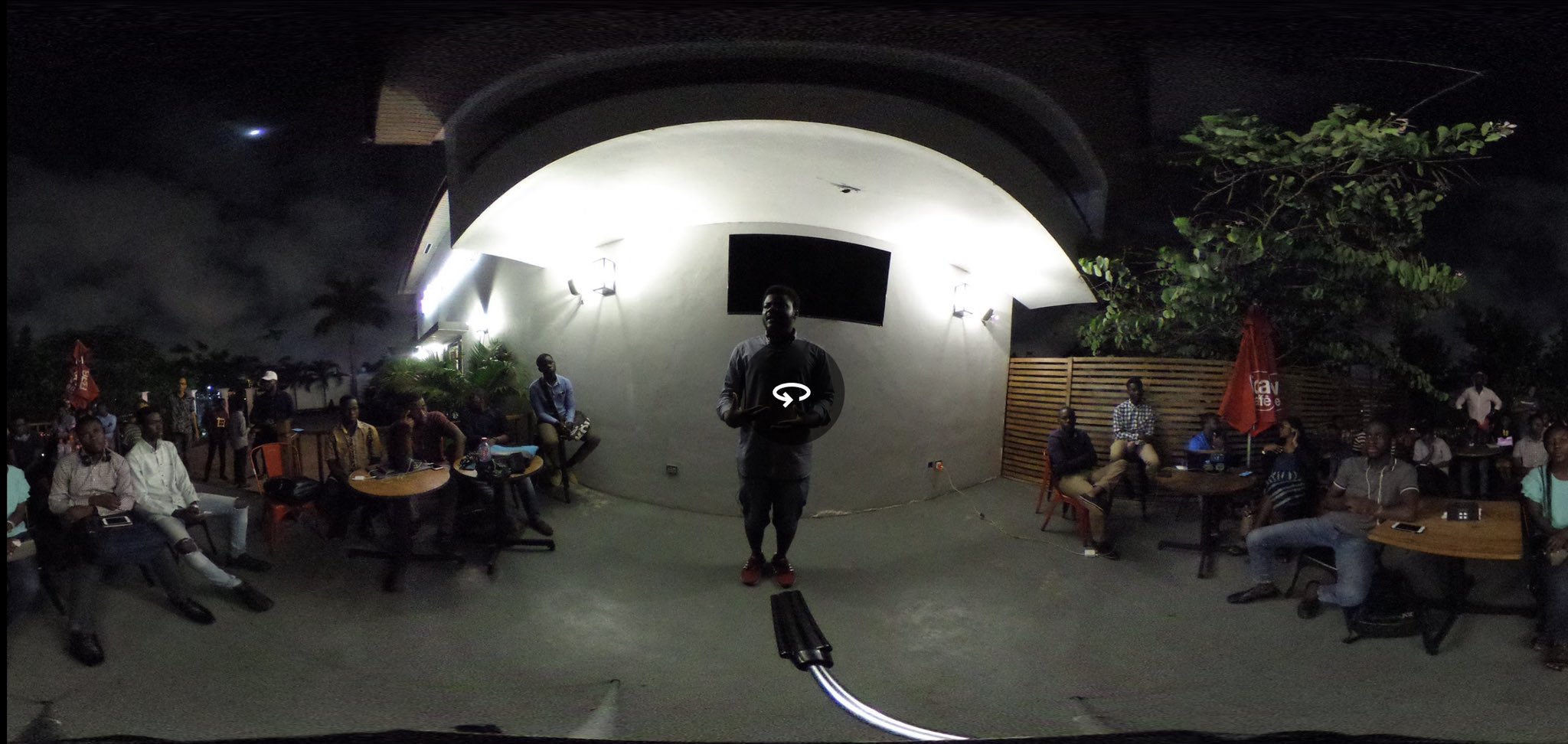
Darlington Ahiale Akogo leads the first Global Lab Science Cafe (360 shot by Barnabas Nomo)

During our very first Science Cafe in August 2018, which was actually part of a series co-initiated with minoHealth dubbed ‘Conversations about Artificial Intelligence’, AI Innovator Darlington Ahiale Akogo gave a talk about AI and how it could influence development on the continent. Since then Global Lab Network has organised six editions, featuring researchers and innovators in public health, technology, mathematics, biotechnology, WASH, urban planning, environmental science, and public policy. These conversations have been useful in re-emphasising the importance of science, technology, and innovation to national development.

DateTopicSpeaker(s)FormatVenue
17 Aug 2018Conversations about Artificial IntelligenceDarlington Ahiale AkogoTalkVida e Caffe, East Legon
19 Jan 2019Co-Design: The Secret to Sustainable WASH InnovationsJacob AmengorPresentationTEMPORARY GARDEN, Airport West
31 May 2019Science & Society: Understanding the Connections between Research, Policy & Practice1. Dr Dzifa Adjaye-Gbewonyo
2. Amma Aboagye
Fireside chatAfrican Science Academy, Tema
29 Nov 2019Enabling Research & Innovation for Sustainable Development1. Dr Angela Tabiri
2. Daniel Osei Ofosu
3. Nii-Ashie “Nash” Adjaye
Talk + Panel Impact Hub Accra
31 Jan 2020What Has Diversity Got to Do with Information Technology Design?Nana Kesewaa DankwaPresentationVida e Caffe, Accra Financial Centre
22 Aug 2020The Coronavirus Crisis – What it Means for Public Health and Wellbeing1. Princess Allotey
2. Dr Mary
3. Eyram Ashinyo
4. Joseph Sam
PresentationGoogle Meet
2 Dec 2020Science & Politics – Exploring STEM Policy Ideas for Election 20201. Fred Otu Larbi
2. Dr Kwame Sarpong Asiedu
3. Dr Andani Kholinar
4. Paul Osei-Kuffour
Roundtable Zoom
Summary of previous Science Cafe events

Since the coronavirus pandemic hit, we have moved all our events, including Science Cafes, online, and this has allowed people from around the world to join the various sessions.

May be an image of 1 person and text that says "METHODS 이. LOGISTIC MODELS Fit the trend in COVID-19 cases 02. NEURAL NETWORKS 小 Princess Allotey Learned from time- series data predict future COVID-19 cases 03. SIRD MODEL 4 Josep Sam 04. NATURAL LANGUAGE PROCESSING k Susceptible-Infected Susceptibl Recovered-Dead (SIRD) model to examine trend of COVID-19 kwesiokyere okyere kwes Used text data to predict whether COVID-19 patient will eventually die survive the pandemic Achieved different evels.of progress with these methods & EBENEZERATOPLEY"
Princess Allotey sharing about data modelling to predict the course of COVID-19 in Africa

Reviews received from Science Cafe speakers and participants after the events have been very positive and encouraging. Aside from learning new things, most attendees also enjoy the interactivity and camaraderie the event evokes. In the good old days before corona, some of us would even stay behind to share food and drinks, talking until it was late.

We’re very glad to be collaborating with the Ghana STEM Network, with support from GhScientific and Digital Times Africa to organise the first Science Cafe of 2021 on Friday 26 March. The theme for this event is “Building Individual and Collective Resilience Beyond the COVID-19 Crisis“. Our goal is discuss the notion of resilience in a time of profound global change by examining experiences, reflections, research findings, and imaginations of what the future could look like or should be like. Some of the key questions we would like to explore include:

  1. What has the crisis changed?
  2. What does ‘resilience’ mean for us as individuals, Ghanaians, and global citizens?
  3. How can we weave through present and future challenges wrought by the pandemic?
  4. How can we utilise available opportunities to build a better future?
  5. What are examples of Ghanaians who have been resilient in these times?
Publicity for March 2021 Science Cafe

Speakers from different professional and disciplinary backgrounds have been drawn from the Ghana STEM Network and beyond to help address these questions. They include Ato Ulzen-Appiah (GhanaThink Foundation), Dr Thomas Tagoe (GhScientific & University of Ghana), Evelyn Agyepong (Independent Education Consultant), Cecil Nutakor (eCampus LLC), and Solomon Appekey (Ghana Planetarium & X Space Solutions). Each speaker will give an input talk at the beginning. Following the input talks, the session will open up for discussions, debates, questions, and responses.

From our experience, Science Cafe has proven to be an effective model of engaging the public with science, technology, and innovation, and further closing the chasm between science and society. Our goal in GLab is to facilitate these conversations and experiences, so that science is embedded in the cultural life of Ghana. If this vision appeals to you, you’re very welcome to join our upcoming Science Cafe or a future edition. RSVP here if you can make it on Friday. See you!

May be an image of 19 people and people smiling
Group picture of participants after Science Cafe as part of Africa Science Week 2019

STEM at Work – Perspectives from Business and Volunteering

Community Call – February

Now more than ever, the interrelated fields of Science Technology, Engineering & Mathematics (STEM) make the world go round. STEM skills are required in diverse settings – in research, industry, and in society. In the month of February, Global Lab Network’s Community Call proved to be very insightful, engaging and beneficial, providing crucial perspectives on STEM at work in business and volunteering. We learnt from speakers Florence Toffa and Sarah Abotsi-Masters on 26 February via Zoom. 

Snapshot of some of the participants in the call

STEM in Business – Perspectives from Mobile Web Ghana

The meeting began with Florence Toffa discussing the mission and vision of Mobile Web Ghana. Mobile Web Ghana is focused on creating a generation of tech change agents and leaders who will use their skills to solve local problems in the community. She iterated that especially during the pandemic there has been a need to hone the skills of different target audiences to be able to fit into various industries. When it comes to work, the pandemic has disrupted how work is done across the board. Florence stated that STEM is critical in every aspect of work.

As a worker, there is the need to rethink how to integrate STEM to make you more efficient. Even as a mom, STEM can be very helpful. A lot has changed, things are not normal and you can not continue to do things the way you do it. We have to redefine the way our work is done.”

Further, she stated that in the current era, employing technology in your work  will greatly improve visibility. “Sometimes STEM is seen in isolation, however you need to involve the community”. She emphasized that  STEM can be deployed in various organizations and combining STEM with various disciplines has the potential to yield huge results.

In conclusion Florence re-emphasized that STEM presents a big opportunity to teach and involve communities to achieve desired change.

Mobile Web Ghana supports capacity building in communities

Volunteering to Make a Difference

Sarah Abotsi-Masters took us on a journey into ‘Astronomy Activities and Volunteering in Ghana’. In her own words, “astronomy is a gateway science”, meaning it is a great way to get children and individuals interested in science. She stated that astronomy is relevant in giving perspective and promoting environmentalism and global citizenship. It also attempts to answer the big questions. Sarah asserted that a lot can be done with space science.

Astronomy is connected to everything. In Ghana , you see very little science journalism and involvement and so little engagement with astronomy. So much can be done  with space science and satellite technology: monitoring galamsey, monitoring coast erosion, monitoring natural disasters and land use.” 

She stated that Ghana can gain a lot from exploring and developing space science.

Sarah concluded her presentation by discussing reasons and benefits of volunteering in the STEM field. These include:

  • Giving back to the community
  • Developing new skills
  • Building your experience, gaining confidence and improving self esteem
  • Meeting new people.

In her closing words she reaffirmed, “Only volunteer because you actually want to. Do the work that is needed and be committed”.

Watch the chat on our YouTube channel and join the Global Lab Ghana Community to stay up to date on our events.

Design a site like this with WordPress.com
Get started